





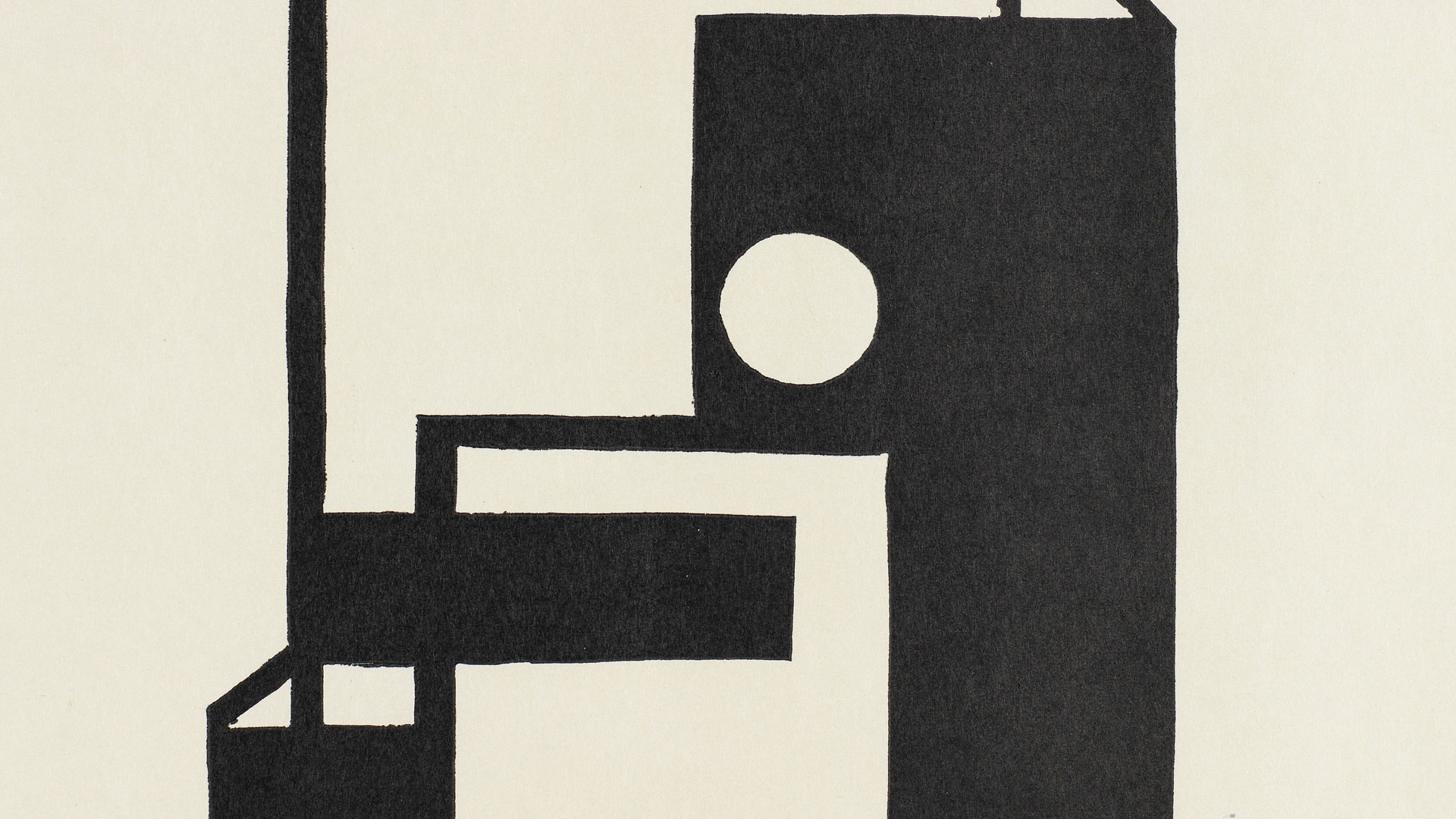


Lajos Kassák: Picture Architecture
-
 June 26 2025 - February 16 2026
 Curator: Nirit Sharon-Debel
-
 Kay Merrill Hillman Gallery
- Artist: Lajos Kassák
The black-and-white prints, created by the Hungarian artist and political activist Lajos Kassák (1887–1967), are an outstanding example of the use of a minimalist aesthetic to call for social change. In the early 20th century, Constructivism’s radical fusion of social critique and artistic approach distilled the message to an abstract, clear arrangement of unadorned geometric forms.
The linocut technique originally employed by Kassák in his “Picture-Architecture” (Bildarchitektur) was extremely well suited to this purpose. The prints’ publication as a portfolio in 1965 testifies to the delayed recognition of his art, as does the Budapest museum that was dedicated to Kassák’s work after his death.
Kassák published a periodical called MA, meaning “today” and short for Magyar Aktivismus (Hungarian activism). The issues displayed in the exhibition include poetry, a novel, and a manifesto by Kassák dating from the 1920s, who also designed their covers. A later cooperation with the Hungarian-French artist Victor Vasarely led in 1961 to a joint portfolio in which six of Kassák’s early works were reproduced as screenprints, two of which can be seen here.

Bildarchitektur
Portfolio; linoleum cut and screenprint, 13/100, 1965
Gift of Robert Lewin, London

 Sep 28Sep 28Sep 30Sep 30
 Sep 27Sep 27Sep 27Sep 28Sep 28Sep 28Sep 29Sep 29Sep 29Sep 30Sep 30Sep 30Oct 01Oct 01Oct 01
 Sep 27Sep 28Sep 29Sep 30Oct 01
 Sep 23Sep 28Sep 30Oct 05Oct 07Oct 12Oct 19Oct 21Oct 26Oct 28
 Sep 23Sep 24Sep 27Sep 28Sep 29Sep 30Oct 01Oct 02Oct 03
 Sep 01Sep 08Sep 15Sep 22Sep 29Sep 29Sep 29
- Sep 27Sep 27Sep 29Sep 29Oct 01Oct 01
 Sep 23Sep 24Sep 27Sep 29Oct 01Oct 05Oct 07Oct 08Oct 12Oct 14Oct 15Oct 19Oct 21Oct 22Oct 26Oct 28Oct 29